


What nobody tells you about towing safely and legally in Australia
The fridge is full, the water tanks are topped up and there’s a bag of firewood in the back. You’ve got a ute rated to tow 3,500 kg and a caravan that weighed less than that when you bought it. Are you right to go? There’s an easy way to find out. Start with what the ute weighs packed for the trip, what the van weighs packed for the trip, and how much of the van’s weight sits on the hitch.
When the kids were growing up, every holiday meant hitching up the camper trailer, behind our Magna wagon or our old Pajero. We racked up thousands of kilometres towing the camper trailer and caravans over the years. Now the kids are grown, we travel lean and light with just the tent. That might change, though, and it got us thinking about towing weights all over again.
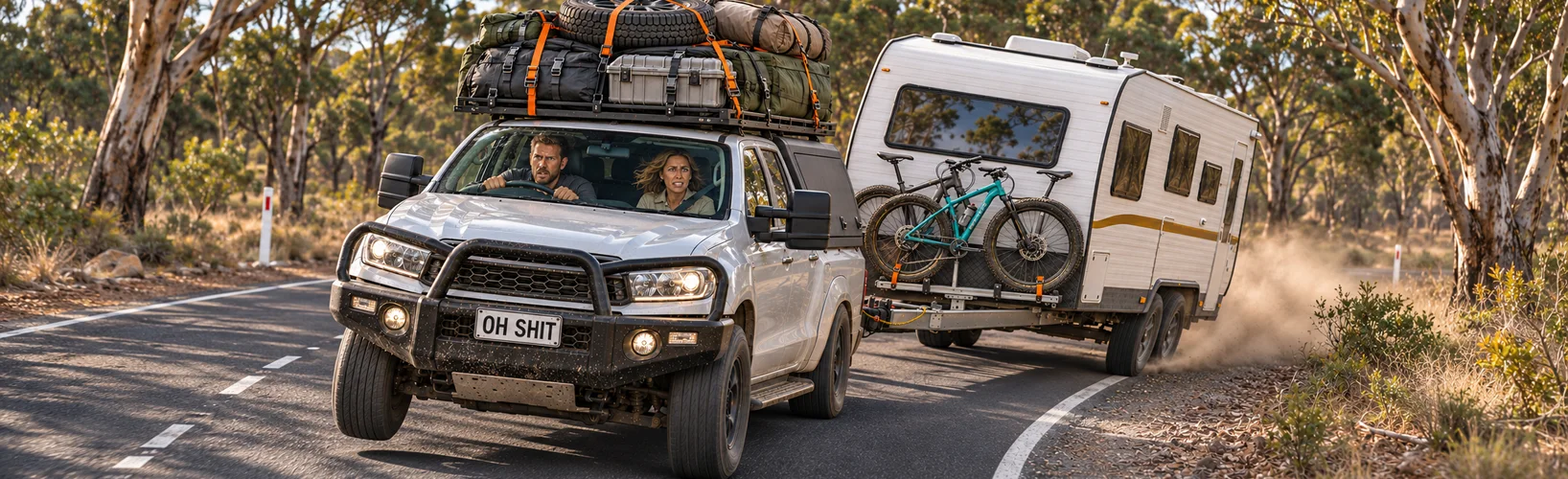
When ‘she’ll be right, mate’ goes wrong
Towing terms in plain English
Before we get into the nitty-gritty, let’s run through a few terms you’ve probably heard people use or seen in a brochure. They’re the words used to describe what your car and trailer weigh and how much they’re allowed to carry. Once those make sense, the towing maths gets a whole lot easier.
Tare Mass (Tare Weight) is the recorded weight of the vehicle or trailer before it’s loaded, under the conditions used to record it. On a caravan plate, it’s the starting weight for the van as originally recorded. Accessories fitted later can make it heavier before you pack a thing.
Kerb Weight is what the manufacturer says the car weighs in ready-to-drive condition, with standard equipment and no people or luggage. Check what fuel and equipment the manufacturer includes. A weighbridge tells you what your own car weighs with its accessories fitted.
Payload is how much weight you can add. On the car, passengers, gear and accessories all use up payload, as does the tow ball weight when you hitch up. In the van, water, food, clothes and added equipment all take up part of its carrying allowance.
GVM (Gross Vehicle Mass) is the most the loaded car is allowed to weigh. Check it against the weight carried by the car’s wheels. When you’re hitched up, that includes the downward load the trailer puts on the tow ball (Tow Ball Weight).
GTM (Gross Trailer Mass) is the most weight the caravan or camper trailer’s wheels are allowed to carry while it’s hitched. Weigh the trailer’s wheels with the trailer still connected to check this limit.
ATM (Aggregate Trailer Mass) is the most the whole loaded caravan or camper trailer is allowed to weigh. That includes the part carried through its wheels and the part carried at the coupling. Weigh the whole trailer unhitched and compare that number with its ATM and the vehicle’s braked towing capacity.
GCM (Gross Combination Mass) is the most the loaded car and loaded caravan or camper trailer can weigh together. Think of it as the limit for everything on the scales when the whole rig rolls onto the weighbridge. If the rig weighs 6,100 kg and its GCM is 6,250 kg, there’s 150 kg left under that limit.
Tow Ball Weight (TBW) is how much the loaded trailer pushes down on the tow ball. It’s part of the trailer’s total weight and uses up some of the car’s payload once you hitch up. Measure it at normal hitch height, follow the manufacturers’ loading guidance and check the lowest applicable limit for the vehicle, towbar, hitch and trailer.
Two other limits to check
Braked towing capacity is the maximum weight the vehicle is rated to tow when the trailer has brakes. Compare this with the weight of the whole loaded trailer. Check the towbar and coupling ratings too and use the lowest applicable limit.
Axle load limit is the most weight an axle is rated to carry. Check the car’s front and rear axles separately with the trailer hitched. The caravan or camper trailer can have axle and tyre limits of its own.
Hopefully those towing terms make a bit more sense now. Let’s put them to work and see what they mean when you’re packing the car, loading the van and getting ready to hitch up. Don’t worry, there is not going to be a test...
Now look at the caravan plate
Suppose the plate lists a 2,000 kg tare. An extra battery, a bike rack and other gear fitted since that weight was recorded can all add to it. Then there’s water, food, clothes, tools and the camp oven. A full 200 litres of water alone adds about 200 kg.
If that same caravan weighs 3,700 kg when packed, the scales are showing 1,700 kg above its recorded tare. That’s a deliberately extreme example. With a 3,500 kg ATM, the caravan itself is 200 kg over its rating. With an approved 3,700 kg ATM, it would be on its ATM limit and still 200 kg too heavy for a vehicle rated to tow 3,500 kg. If the 2,000 kg on the plate was actually marked ATM, then 2,000 kg is the caravan’s loaded limit.
What changes when you hitch up?
Say a ute has a 3,200 kg GVM and weighs 2,450 kg with a full tank, towbar, canopy and drawers fitted. At that point it has 750 kg left under GVM. Add 350 kg for passengers, the fridge and gear, and there’s 400 kg left. Hitch up a van that puts 300 kg on the ball and there’s 100 kg left under GVM. You still need to check the axles and the combined weight.
Picture a loaded van weighing 3,300 kg on its own. Once it’s hitched, its wheels carry 3,000 kg and the tow ball carries 300 kg. If the packed ute weighs 2,800 kg before hitching, its wheels now carry 3,100 kg in this example.
To check against GCM, you can work out the combined weight two ways. Both give you the same total.
| How you weigh it | What you add | Combined weight |
|---|---|---|
| Separately | 2,800 kg packed ute unhitched + 3,300 kg whole van unhitched | 6,100 kg |
| Hitched | 3,100 kg through the ute’s wheels + 3,000 kg through the van’s wheels | 6,100 kg |
The 300 kg on the ball is part of the van’s total weight and part of what the ute carries when hitched. If you add the hitched ute’s weight to the whole unhitched caravan’s weight, you’ve counted those 300 kg twice.
There’s one more number worth asking for at the weighbridge. The ball sits behind the rear axle, so the hitch can add more than 300 kg to the rear axle while taking some load off the front axle. A ute can be under its GVM and still be over its rear axle rating. A tow ball weight of around 10% of the loaded caravan’s weight is a rough guide. Follow the vehicle and caravan manufacturers’ guidance and measure your own setup.
Same tow rating, different weight limits
Take a 25MY Mitsubishi Triton GLS 4WD double-cab pick-up with the 3,200 kg GVM rating and a Toyota LandCruiser 300 GXL diesel wagon. Both are rated to tow 3,500 kg braked. To see what the different ratings mean, assume each vehicle weighs 2,800 kg packed and unhitched, and the whole loaded caravan weighs 3,500 kg. That’s 6,300 kg together.
| Manufacturer rating or example result | Triton GLS | LandCruiser 300 GXL diesel |
|---|---|---|
| Braked towing limit | 3,500 kg | 3,500 kg |
| GVM | 3,200 kg | 3,280 kg |
| GCM | 6,250 kg | 6,750 kg |
| Example result against GCM | 50 kg over | 450 kg under |
If the caravan puts 350 kg on the ball in this example, each vehicle’s wheels carry 3,150 kg when hitched. Both are under GVM, yet the Triton is still over GCM. The LandCruiser has 450 kg left under GCM, but only 130 kg left under GVM. That’s why you check both numbers, along with the axle, tyre, tow ball, towbar, coupling and caravan limits. The packed weights are hypothetical. Verify the ratings for your exact model and build.
What about a GVM upgrade?
A GVM-only upgrade lets you carry more in the ute. Your total allowance for the ute and caravan together stays the same, and so does the ute’s braked tow rating. If you put another 200 kg in the ute, you have 200 kg less room for the caravan under GCM.
Take the Triton from our example. Say an approved upgrade raises its GVM from 3,200 kg to 3,500 kg, while its GCM stays at 6,250 kg. Here’s what happens when you put another 200 kg in the ute.
| What the packed ute weighs before hitching | Room left for the whole loaded caravan under GCM |
|---|---|
| 2,750 kg | 3,500 kg |
| 2,950 kg | 3,300 kg |
With the ute at 2,950 kg and a 3,500 kg caravan, the whole rig weighs 6,450 kg. That’s 200 kg over GCM, even though the caravan is within the ute’s braked tow rating. The figures in the table only check GCM. You’ll still need to check the hitched ute against its GVM and axle ratings, as well as the caravan and tow ball limits.
A higher GCM needs a separate re-rating recognised by your state or territory. If a kit is advertised as a GVM and GCM upgrade, ask your registration authority or a licensed certifier to confirm which ratings apply to your exact vehicle.

Weighed, packed, legal, safe and off into the sunset for more adventures
Weigh it packed the way you’ll actually travel
Police have weighed tow vehicles and caravans at roadside checks in NSW, Victoria and Queensland. If you’re over a legal weight limit, you can be fined, and an unsafe rig can attract a defect notice. An overloaded rig can be harder to stop and control, and overloading can affect an insurance claim depending on the policy and circumstances.
A fine is one thing. Overloading either the tow vehicle or the caravan can make the whole rig harder to control. If an overloaded caravan starts to sway badly, it can pull the tow vehicle out of line and the whole rig can jackknife, roll over or crash. ‘She’ll be right, mate’ is a bad bet when you’ve got a few tonnes behind you.
Those weight limits are there for a reason. They’re the maximums the manufacturers have rated the vehicle and trailer to handle safely. The compliance plate gives you the trailer’s rated limits and may list its original tare weight. The scales tell you what your caravan or camper trailer actually weighs with everything packed. Weigh the tow vehicle and trailer as you’ll travel, use those readings in your maths and take weight out if you’re over a limit. Then weigh again before you head off.
- Find your limits. Start with the vehicle handbook, caravan plate and towbar and coupling ratings. Have the vehicle’s front and rear axle limits handy.
- Pack for a heavy travel day. Include the passengers and pets, full fuel, the water and gas you’ll actually carry, food, bikes, tools and all the gear you usually take. Allow for any extra water or supplies you’ll pick up during the trip.
- Book a public weighbridge or a mobile caravan weighing service. Ask beforehand if they can measure the full combination, the loaded ute unhitched, the loaded caravan unhitched, the tow ball weight, and the individual axle loads while hitched. Follow the operator’s directions about where to park and unhitch.
- Compare each reading with its matching limit. If one is over, remove weight or get advice on redistributing it safely, then weigh again. Moving gear between the ute and van changes where the weight sits. The whole rig still weighs the same. Keep the results and recheck after significant changes to the setup.
If you’re still shopping for a caravan, weigh your packed tow vehicle before signing. Take that figure with you when you look at vans and ask what each one weighs with the options you want. You’ll get a much clearer idea of what you can take away with you, right down to whether there’s room for that bag of firewood.
Sources and further reading
- Weights and safe towing · NSW caravan towing rules · Australian light trailer standards · Caravan Clubs of Queensland weighing guide
- Vehicle specifications · Mitsubishi Triton · Toyota LandCruiser 300
- Upgrades and roadside checks · Queensland GCM re-rating code · Roadside weighing examples · NSW defect notices
- Sway and insurance · South Australian caravan safety advice · Example insurer overloading exclusion