

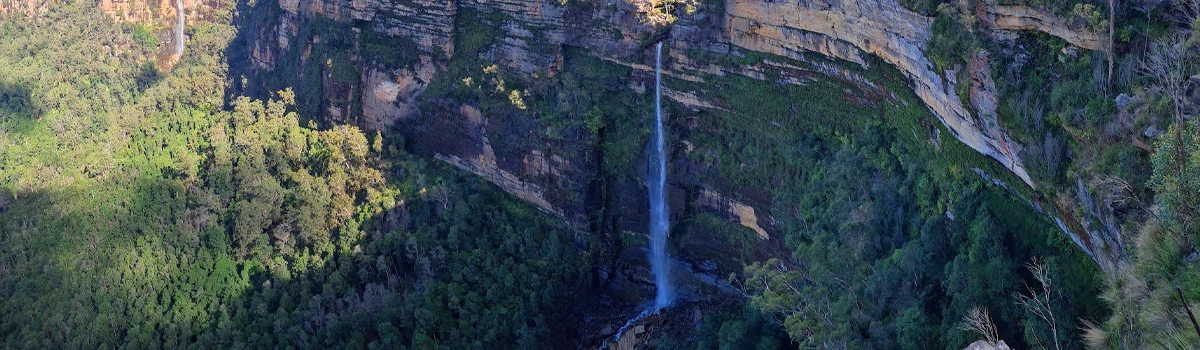
Horseshoe Falls are one of the tallest single-drop waterfalls in the Blue Mountains and may be second only to nearby Govetts Leap. Both waterfalls plunge from the eastern escarpment at Blackheath into the immense Grose Valley below.
The falls take their name from the broad, horseshoe-shaped section of cliff over which the water flows. They have also appeared in historical records under the names Left Hand Falls and Piguenit’s Fall.
One of the best views is from Cripps Lookout on the Pulpit Rock walking track. The walk begins from Govetts Leap Lookout rather than Evans Lookout, with Cripps Lookout reached after approximately 20 minutes. From the fenced viewing area, Horseshoe Falls dominate the cliffs to one side, while Govetts Leap can also be seen across the valley.
Horseshoe Falls are highly dependent on recent rainfall and may become very faint during extended dry periods. After sustained rain, however, they transform into an enormous white column of water plunging from the escarpment. Strong winds can catch the falling water and sweep it sideways across the cliff, sometimes breaking the waterfall into clouds of drifting spray.
The view from Cripps Lookout shows the full scale of the drop far better than the closer Horseshoe Falls Lookout, where the waterfall is almost directly below and only part of it can be seen.
The walking track is well defined but includes steps, uneven ground and some elevation changes. Families accustomed to bushwalking should manage the walk, although children must remain behind the barriers because of the immense cliffs surrounding the viewpoints.
When flowing strongly, Horseshoe Falls are an extraordinary sight and one of the most impressive waterfalls visible from the Blackheath escarpment.
Gallery